Unsold Clothes Ban: Can It Really Reduce Fashion Waste?
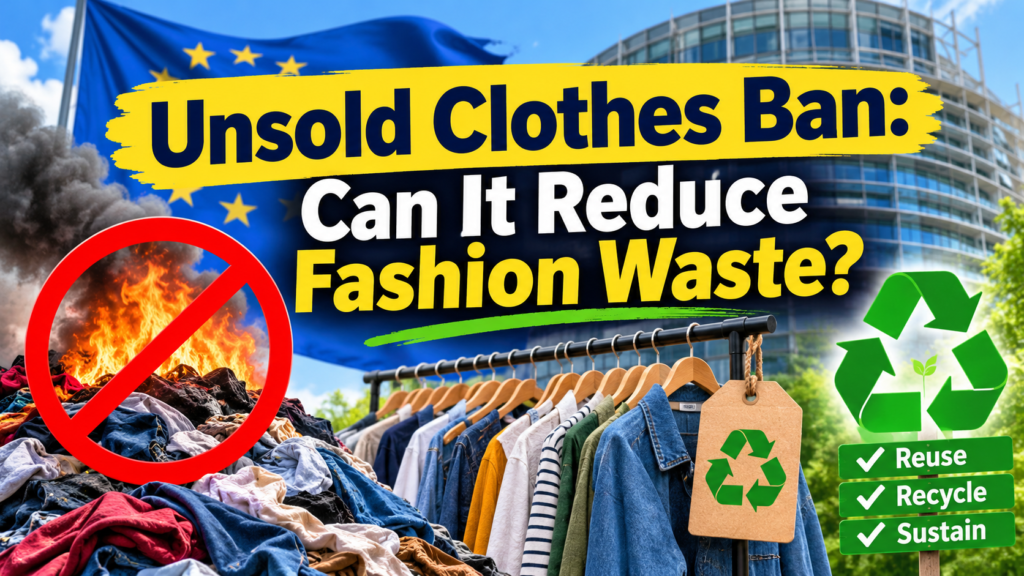
Unsold Clothes Ban is a major step by the European Union towards reducing fashion waste. Introduced on 19 July 2026, this regulation prevents large companies from destroying unsold clothing, clothing accessories, and footwear. Instead, businesses are encouraged to reuse, resell, repair, and donate these products.
On 19 July 2026, the European Union introduced a major step towards making the fashion industry more sustainable. Under a new regulation, large companies can no longer destroy unsold clothing, clothing accessories, and footwear simply because these products have not been sold.
For years, fashion brands have faced criticism for producing more clothing than consumers actually need. Yet one of the industry’s most wasteful practices has often remained out of sight: destroying brand-new garments that are still perfectly usable.
From luxury labels protecting their exclusivity to retailers clearing warehouse space for new collections, unsold clothing has been incinerated, shredded, or sent to landfill. The EU’s new unsold clothes ban aims to change that.
But will preventing the destruction of unwanted stock genuinely reduce fashion waste? Or will brands simply find other ways to move their surplus products elsewhere?
Let’s explore what the regulation means, why it matters, and what challenges lie ahead.
The Unsold Clothes Ban introduced by the European Union on 19 July 2026 marks an important step towards reducing fashion waste. Under the new regulation, large companies can no longer destroy unsold clothing, clothing accessories, and footwear simply because these products have not been sold. Instead, businesses are encouraged to prioritize reuse, resale, repair, and donations.
What Is the EU Unsold Clothes Ban?
The European Union has prohibited large companies from destroying unsold apparel, clothing accessories, and footwear under the Ecodesign for Sustainable Products Regulation (ESPR).
Instead of treating excess inventory as disposable, businesses are expected to prioritize more sustainable alternatives, including:
- Reselling unsold products
- Reusing and repairing garments
- Remanufacturing clothing
- Donating usable products
Destruction is permitted only in limited circumstances, including when products present health or safety risks, are counterfeit, or are irreparably damaged.
The requirements will also extend to medium-sized companies from 2030.
At first glance, the regulation seems straightforward. Preventing companies from destroying perfectly usable clothing is an obvious step towards reducing waste. However, the bigger challenge is understanding why so many garments remain unsold in the first place.
The regulation addresses the disposal of excess stock, but it does not automatically solve the overproduction that creates it.
Why Does the Fashion Industry Destroy Unsold Clothes?
To understand the importance of the unsold clothes ban, it is necessary to look at how the fashion industry operates.
Fashion businesses depend heavily on trends, seasonal collections, and changing consumer preferences. Every new collection creates pressure to sell existing stock before demand shifts towards the next trend.
When products remain unsold, companies face several choices: store them, discount them, donate them, recycle them, or dispose of them.
For some businesses, destroying unsold products has historically been considered a way to protect brand value.
Luxury Brands and the Problem of Exclusivity
Luxury fashion companies often rely on exclusivity to maintain their premium image. Selling large quantities of products through heavy discounts or clearance sales can weaken that perception.
As a result, some luxury brands have historically viewed destroying excess inventory as a way to prevent unwanted products from entering discount markets.
Fast Fashion and Constant New Collections
Fast-fashion businesses face a different challenge. Their business models depend on introducing new styles quickly and responding to rapidly changing trends.
Unsold products take up warehouse space and tie up working capital. When trends change within weeks, storing outdated inventory can become an expensive business decision.
Online Shopping and Customer Returns
Online shopping has created another challenge: product returns.
Returned clothing may require inspection, cleaning, repackaging, or repairs before it can be sold again. For inexpensive garments, the cost of processing a return can sometimes exceed the product’s value.
These factors help explain why unsold and returned clothing has become a significant environmental concern.
According to the European Environment Agency (EEA), an estimated 4–9% of textile products placed on the European market are destroyed before being used. This represents approximately 264,000 to 594,000 tonnes of textiles every year.
Processing and destroying these returned and unsold textiles is estimated to generate up to 5.6 million tonnes of CO₂-equivalent emissions annually.
These figures reveal a major inefficiency: resources, energy, water, and labour are consumed to manufacture garments that may never be worn.
Can the Unsold Clothes Ban Reduce Fashion Waste?
The short answer is yes, but its impact has limitations.
Preventing usable garments from being destroyed can reduce one visible source of textile waste. More products may instead be resold, reused, repaired, donated, or recycled.
However, fashion’s environmental impact begins long before a garment becomes unsold.
It starts with raw material extraction, fibre production, fabric dyeing, manufacturing, packaging, and transportation. By the time a garment reaches a warehouse, a significant part of its environmental footprint has already been created.
This is why preventing unnecessary production is often more effective than simply finding better ways to manage unwanted products.
Recycling and reuse are important, but they cannot fully compensate for an industry that continuously manufactures more clothing than consumers need.
Ultimately, the most sustainable garment may be the one that never needed to be produced in the first place.
Could the EU Ban Simply Move Fashion Waste Somewhere Else?
One important concern is that environmental regulations can sometimes move a problem rather than eliminate it.
If brands can no longer destroy unsold clothing within Europe, they may increasingly turn to alternative channels such as outlet stores, secondary marketplaces, overseas distributors, or international resale networks.
This raises a difficult question: what happens if excess clothing continues to be produced but is simply sent somewhere else?
For decades, developing countries have received large quantities of second-hand clothing from wealthier economies. These imports can support affordable clothing markets and provide livelihoods for traders, repair businesses, and recyclers.
However, when the volume of low-value clothing becomes too large, local waste-management systems can struggle to cope.
Places such as Kantamanto Market in Ghana and Chile’s Atacama Desert have become widely recognized examples of the environmental challenges associated with excess textile consumption.
It is important to note that much of the clothing reaching these locations comes through second-hand markets, rather than directly from unsold European inventory. Nevertheless, they illustrate how the consequences of excessive textile consumption can extend beyond the countries where clothing is originally sold.
Whether the EU regulation will increase this pressure remains uncertain.
If brands simply redirect surplus products into international markets, the location of textile waste could change without reducing the amount of clothing being produced.
But if companies respond by manufacturing fewer garments and improving inventory planning, the amount of surplus entering global markets could decline.
The real measure of success will therefore be whether the industry produces less unnecessary clothing.
What Happens Next for the Fashion Industry?
The long-term impact of the unsold clothes ban will depend largely on how fashion companies adapt.
Businesses may increasingly rely on outlet stores, resale platforms, donations, rental services, and recycling programmes to manage excess inventory.
Some may also introduce deeper discounts and more promotional campaigns to clear seasonal stock.
However, these solutions address what happens after clothing has already been produced. A more meaningful change would involve preventing surplus inventory from being created.
Brands could achieve this by improving demand forecasting, producing smaller batches, monitoring customer preferences, and making supply chains more responsive.
Technology may also play an important role. Artificial intelligence, predictive analytics, and digital inventory systems can help businesses estimate demand more accurately and avoid manufacturing products that are unlikely to sell.
Could the Ban Accidentally Encourage Overconsumption?
There is another question worth considering: could making unsold clothing more widely available through discounts and resale encourage people to buy more?
There is not yet clear evidence that the regulation will produce this outcome. However, it is a possibility worth monitoring.
If more excess inventory reaches consumers through aggressive discounts, shoppers may be tempted to purchase products simply because they are cheaper.
Frequent promotions can also reinforce the idea that clothing is disposable rather than something worth keeping, repairing, and using for longer.
On the other hand, the regulation could encourage brands to rethink their production strategies.
Holding unsold inventory can be expensive. As businesses look for ways to avoid surplus stock, they may have stronger incentives to produce smaller quantities and align manufacturing more closely with actual demand.
That could represent an important shift for an industry that has traditionally associated commercial success with producing and selling more.
Unsold Clothes Ban: A Significant Step, but Not the Final Answer
The EU’s decision to prohibit large companies from destroying unsold clothing marks an important development in the movement towards a circular fashion economy.
It sends a clear message: perfectly usable products should not be treated as disposable simply because they have not been sold.
However, preventing destruction is only one part of the solution.
The deeper challenge is reducing the overproduction and overconsumption that create excess inventory in the first place. Without changes to how clothing is designed, manufactured, marketed, and purchased, textile waste will remain a major environmental concern.
If fashion brands use this regulation to improve demand forecasting, create more responsive supply chains, and manufacture closer to actual consumer demand, it could become a catalyst for lasting change.
But if surplus clothing is simply redirected through discounts, exports, or alternative disposal channels, the problem may take a different form rather than disappear.
The real success of the unsold clothes ban will not be measured only by how many garments are saved from destruction. It will be measured by whether the fashion industry learns to produce less, waste less, and make better use of the resources it consumes.