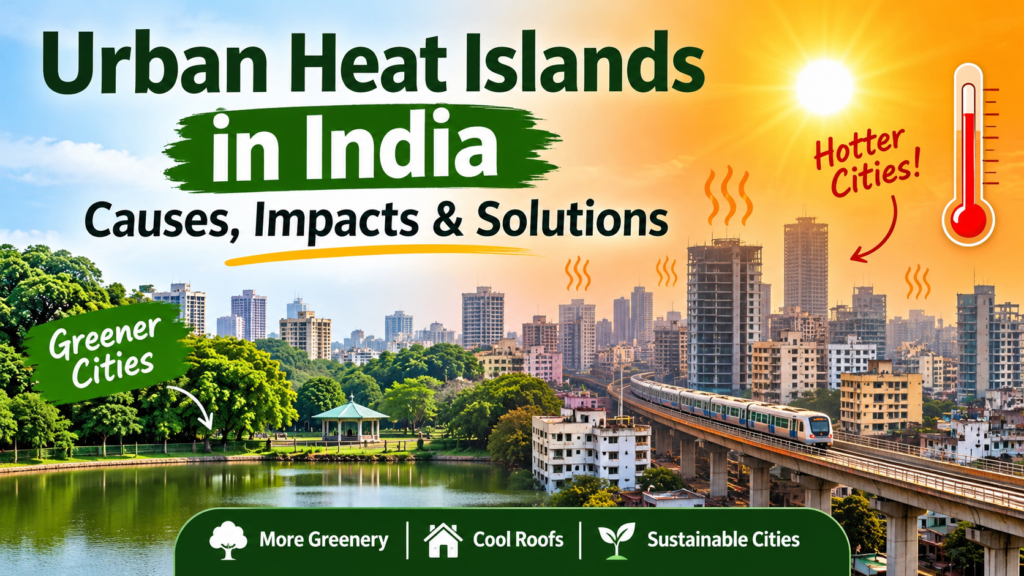
UHI in India: Causes, Effects & Solutions (2026)
India’s rapidly growing cities are facing an important environmental challenge: rising urban temperatures. UHI in India (Urban Heat Island in India) is becoming an increasingly important topic in environmental research, sustainable development and climate-resilient urban planning.
The Urban Heat Island effect occurs when built-up urban areas become warmer than nearby rural surroundings. Concrete buildings, asphalt roads, reduced vegetation, industrial activities and increasing energy consumption can all contribute to this phenomenon.
From Delhi and Mumbai to Kolkata and Bengaluru, urban heat creates challenges for public health, electricity consumption, outdoor comfort and environmental sustainability.
As India’s cities continue to expand, understanding UHI in India is essential for creating healthier and more climate-resilient communities.
In this guide, we explore the causes, environmental impacts, recent research, government initiatives and practical solutions to reduce urban heat in India.
What Is UHI in India?
UHI stands for Urban Heat Island. UHI in India describes the phenomenon in which urban areas experience higher temperatures than their surrounding rural areas because of differences in land use, construction materials, vegetation and human activities.
Urban surfaces such as concrete, asphalt, brick and metal absorb solar radiation during the day and gradually release the stored heat. Buildings can also restrict natural airflow, while vehicles, industries and air-conditioning systems release additional heat into the environment.
The UHI effect can occur during both daytime and nighttime. In some locations, urban areas remain warmer after sunset because buildings and roads continue releasing the heat accumulated throughout the day.
There are two major types of Urban Heat Islands:
1. Surface Urban Heat Island
Surface UHI refers to differences in the temperature of urban surfaces, including rooftops, roads, pavements and other built-up areas.
Satellite images and thermal remote-sensing technologies can help researchers identify these temperature differences.
2. Atmospheric Urban Heat Island
Atmospheric UHI refers to differences in the air temperature between urban and surrounding rural environments.
It is influenced by building density, vegetation, wind conditions, human activities and the characteristics of the local atmosphere.
Understanding both types is important when developing effective UHI solutions in India.
Why Is UHI in India Becoming a Growing Concern?
Rapid urbanisation is changing India’s natural landscapes. Trees, wetlands, agricultural areas and open spaces are increasingly being replaced by buildings, roads, parking areas and commercial infrastructure.
A 2026 systematic review of UHI research covering more than 40 Indian cities identified vegetation loss, impervious surfaces, unplanned urban expansion and human-generated heat as important contributing factors.
The following are some of the major causes of UHI in India.
1. Loss of Trees and Green Spaces
Trees naturally cool their surroundings by providing shade and releasing water vapour through evapotranspiration.
When trees are removed for construction and infrastructure development, cities lose an important natural cooling system.
Fewer trees also allow more direct sunlight to reach roads, buildings and pavements, increasing heat absorption.
Protecting existing trees and expanding urban green spaces should therefore be a priority for reducing UHI in India.
2. Concrete Buildings and Asphalt Roads
Concrete, asphalt, bricks and other construction materials absorb and store solar energy.
Dark roads, rooftops, parking areas and concrete structures can become extremely hot during sunny conditions. They gradually release stored heat into the surrounding environment.
The expansion of impermeable surfaces also reduces natural water infiltration and can limit opportunities for evaporative cooling.
3. Increasing Vehicle Traffic
Cars, buses, motorcycles and trucks release waste heat through their engines and exhaust systems.
Traffic congestion can increase heat emissions in busy urban neighbourhoods. Vehicle emissions also contribute to air pollution, creating additional environmental and public-health challenges.
Sustainable transport systems can help reduce these pressures.
4. Industrial and Commercial Activities
Factories, power systems, commercial buildings, data centres and other energy-intensive facilities can release heat into their surroundings.
Areas with concentrated industrial activity and limited vegetation may experience additional local heat stress.
Improving energy efficiency and introducing green infrastructure can help businesses reduce their environmental impact.
5. Increasing Air-Conditioning Demand
Rising temperatures increase the demand for air conditioning in homes, offices, shopping centres and other buildings.
Air-conditioning systems transfer indoor heat to the outdoor environment. When many systems operate in a concentrated area, they can contribute to local outdoor heat.
Higher electricity consumption can also increase pressure on power infrastructure.
6. Unplanned Urban Expansion
Rapid construction without adequate green spaces, ventilation corridors and water-sensitive planning can create neighbourhoods that retain more heat.
Dense development, limited tree cover and insufficient public spaces can make urban areas more vulnerable to extreme temperatures.
Climate-responsive urban planning is essential to address this problem.
UHI in India: Effects on People and the Environment
The UHI effect is more than a temperature difference. It can affect public health, energy consumption, infrastructure and the overall quality of urban life.
1. Increased Heat-Related Health Risks
Higher temperatures can increase the risk of dehydration, heat exhaustion and heatstroke, particularly during heatwave conditions.
Older adults, children, outdoor workers and people living in poorly ventilated homes may face greater exposure to heat stress.
Reducing urban heat is therefore an important public-health priority.
2. Higher Electricity Consumption
Hotter urban neighbourhoods increase the demand for fans, air conditioning and other cooling systems.
This can increase electricity bills for households and operating expenses for businesses.
Higher peak electricity demand may also put additional pressure on power infrastructure.
3. Air Pollution and Environmental Pressure
High temperatures, sunlight, atmospheric conditions and emissions interact in complex ways.
Some pollutants, including ground-level ozone, can become more problematic under hot and sunny conditions.
UHI management should therefore be considered alongside air-quality improvement and sustainable transportation policies.
4. Reduced Outdoor Comfort and Productivity
Extreme urban heat can make walking, cycling, outdoor work and recreational activities more difficult.
Construction workers, street vendors, delivery personnel, traffic workers and other outdoor employees may face particularly high heat exposure.
Providing shade, hydration facilities and safer working arrangements is important.
5. Increased Pressure on Water Resources
Hotter conditions can increase demand for water for households, landscaping and cooling.
Urban areas experiencing water shortages may face additional challenges during periods of extreme heat.
Protecting lakes, wetlands and other natural water bodies is important for long-term environmental resilience.
6. Greater Climate Vulnerability
The UHI effect can intensify local heat exposure during extreme weather.
When urban heat combines with heatwave conditions, vulnerable communities may face increased risks.
This makes UHI reduction an important part of climate adaptation and disaster preparedness.
UHI in Major Indian Cities: Delhi, Mumbai, Kolkata and Bengaluru
The intensity of urban heat varies according to geography, climate, building density, vegetation, land use and weather conditions.
Here are some important examples of UHI-related challenges across Indian cities.
UHI in Delhi
Delhi experiences severe summer heat. Dense construction, paved surfaces, traffic and limited vegetation in some neighbourhoods can contribute to local urban warming.
The city’s climate vulnerability assessments have highlighted the importance of cool roofs, cooling corridors, urban green infrastructure and heat action planning.
Expanding tree cover, improving public transport and protecting water bodies can support better heat resilience.
UHI in Mumbai
Mumbai’s dense development, extensive paved surfaces and limited open spaces in some neighbourhoods create challenges for urban cooling.
Protecting mangroves, wetlands and coastal ecosystems is important for maintaining environmental balance.
The city can also benefit from more shaded pedestrian areas, urban forests and climate-sensitive building design.
UHI in Kolkata
Kolkata is an important example of why UHI in India needs city-specific research and solutions.
A 2026 research study examined urban heat and pollution patterns across the Kolkata Metropolitan Area between 2001 and 2024.
The study reported higher nighttime and daytime land surface temperatures in the urban region than in surrounding rural areas, alongside differences in air pollution indicators.
These findings highlight the importance of protecting vegetation, restoring water bodies and improving urban environmental planning.
Practical priorities for Kolkata include:
- Protecting mature trees and neighbourhood greenery.
- Restoring ponds, lakes and other urban water bodies.
- Increasing shaded pedestrian spaces.
- Encouraging reflective and heat-resistant roofing.
- Improving public transport and reducing traffic congestion.
- Integrating heat-risk information into city planning.
UHI in Bengaluru
Bengaluru’s rapid urban expansion has increased the importance of protecting lakes, tree cover and open spaces.
Research published in 2026 examining Bengaluru’s built-up expansion found a strong relationship between increasing built-up and population density and urban heat exposure.
Lake restoration, urban forestry, green building design and better land-use planning can help improve the city’s thermal environment.
UHI in Other Indian Cities
Urban heat is not limited to major metropolitan areas.
Growing Tier-2 and Tier-3 cities also need heat-sensitive development strategies.
As these cities expand, protecting natural landscapes, creating public parks, improving building design and planning sustainable transport can help prevent future heat-related problems.
8 Effective Solutions to Reduce UHI in India
Reducing UHI requires cooperation between governments, businesses, building owners, urban planners and residents.
The following solutions can help create cooler and more sustainable cities.
1. Increase Urban Tree Cover
Planting and protecting trees is one of the most practical approaches to improving outdoor thermal comfort.
Trees provide shade and cool their surroundings through evapotranspiration.
Indian cities should prioritise:
- Planting native and climate-appropriate tree species.
- Protecting mature trees during construction.
- Developing green corridors.
- Increasing tree cover around roads and public spaces.
- Maintaining parks and neighbourhood gardens.
Tree planting should include long-term maintenance and responsible water management.
2. Promote Cool Roof Technology
Cool roofs use reflective materials or coatings to reduce the amount of solar energy absorbed by rooftops.
They can lower roof surface temperatures and help reduce indoor heat gains, depending on building design and local conditions.
Schools, hospitals, residential buildings, factories and commercial properties can explore cool-roof solutions.
3. Develop Green Roofs and Green Walls
Green roofs introduce vegetation on suitable rooftops, while green walls cover parts of building exteriors with plants.
These solutions can provide shade, support biodiversity and improve building-level thermal performance.
However, installation requires appropriate structural assessment, drainage, waterproofing and maintenance.
4. Protect Lakes, Wetlands and Water Bodies
Lakes, ponds, wetlands and rivers are valuable parts of urban ecosystems.
Protecting these natural systems can support biodiversity, water management and environmental resilience.
Cities should prevent encroachment, restore degraded water bodies and connect blue spaces with green corridors.
5. Use Heat-Responsive Building Materials
Reflective and appropriately insulated building materials can reduce heat absorption and improve indoor comfort.
Buildings should also incorporate:
- Roof insulation.
- External shading.
- Cross-ventilation.
- Energy-efficient windows.
- Appropriate building orientation.
- Passive cooling design.
These measures can reduce dependence on mechanical cooling.
6. Improve Sustainable Public Transport
Traffic congestion and vehicle-related emissions create additional environmental pressures in urban areas.
Cities should promote reliable public transport, safe cycle lanes and accessible pedestrian routes.
Shaded footpaths and green transport corridors can also make walking and cycling more comfortable.
7. Create More Urban Parks and Green Corridors
Parks, roadside plantations, green playgrounds and connected green corridors can provide cooler outdoor spaces.
Green spaces should be distributed across different neighbourhoods so that cooling benefits are accessible to all communities.
8. Introduce Climate-Responsive Urban Planning
Urban heat should be considered during city master planning, building approvals and infrastructure development.
Planners can:
- Map heat-vulnerable neighbourhoods.
- Identify areas with limited vegetation.
- Protect natural ventilation pathways.
- Increase shaded public spaces.
- Preserve wetlands and urban forests.
- Prioritise cooling interventions in vulnerable communities.
This approach can help Indian cities prepare for future heat risks.
Government Initiatives Addressing UHI in India
India’s approach to urban heat management includes disaster preparedness, Heat Action Plans, urban greening and climate-sensitive urban development.
The Ministry of Housing and Urban Affairs reported in July 2026 that Heat Action Plans had been prepared across 23 states, 195 districts and 64 cities, based on information received by the government.
The National Disaster Management Authority’s heatwave guidelines recommend that cities assess factors contributing to the Urban Heat Island effect and include suitable mitigation measures in their Heat Action Plans.
The government has also reported a pilot programme under AMRUT 2.0 called Building Heat Resilient Cities: A Strategic Pilot for Urban India.
The programme covers 12 cities:
- Bengaluru
- Bhopal
- Dehradun
- Ghaziabad
- Gwalior
- Gurugram
- Guwahati
- Jodhpur
- Ludhiana
- Nashik
- Vadodara
- Visakhapatnam
The pilot aims to assess urban heat stress, identify vulnerable locations and develop city-specific recommendations involving urban greening, water-sensitive planning and passive cooling.
Other relevant government measures include:
Urban Green Guidelines, 2014: Encourage green infrastructure and improved urban environmental planning.
Urban and Regional Development Plans Formulation and Implementation Guidelines, 2014: Include planning principles related to vegetation, open spaces, water bodies and climate-responsive development.
India Cooling Action Plan: Provides a broader vision for sustainable cooling, reducing cooling demand and improving energy efficiency.
These initiatives demonstrate why UHI reduction needs to become part of long-term urban development.
How Individuals and Businesses Can Help Reduce UHI in India
Reducing urban heat is a shared responsibility. Individuals, housing societies and businesses can take practical steps.
What Individuals Can Do
- Plant and maintain suitable trees and native plants.
- Use reflective or cool-roof materials where practical.
- Add shade to balconies, terraces and outdoor spaces.
- Reduce unnecessary electricity consumption.
- Choose public transport, walking or cycling when feasible.
- Support local parks and water-body conservation.
- Participate in neighbourhood cleanliness and tree-care initiatives.
What Businesses Can Do
- Conduct building energy and heat assessments.
- Explore cool roofs and passive cooling systems.
- Improve energy efficiency and ventilation.
- Increase greenery around business premises.
- Provide heat-safety measures for outdoor employees.
- Include climate resilience in sustainability and ESG strategies.
- Consider heat exposure when planning new infrastructure.
Businesses can also work with sustainability consultants to assess climate risks and develop practical environmental improvement plans.
Future of UHI in India: Building Climate-Resilient Cities
India’s urban future will depend not only on how quickly cities grow but also on how sustainably they develop.
A systematic review published in Frontiers in Sustainable Cities in January 2026 examined UHI research covering more than 40 Indian cities. It highlighted vegetation loss, impervious surfaces, unplanned urban expansion and human-generated heat as important drivers.
The review also identified the need for more research in smaller and medium-sized cities and better understanding of atmospheric and canopy-layer urban heat.
A separate 2026 study of urban heat exposure in India found that population growth and urban warming both contributed to increasing exposure to extreme heat between 1983 and 2016.
These findings underline an important point: there is no single solution for every Indian city.
Coastal cities, inland metropolitan areas and rapidly growing smaller cities may experience different environmental conditions. Their UHI management strategies must reflect local geography, climate, building patterns and community needs.
Better urban data, scientific heat mapping, effective Heat Action Plans, green infrastructure and climate-responsive buildings can help cities make more informed decisions.
The future of UHI in India depends on turning scientific knowledge into practical urban development.
Frequently Asked Questions About UHI in India
1. What does UHI in India mean?
UHI in India refers to the Urban Heat Island phenomenon in which built-up urban areas become warmer than nearby rural surroundings because of construction materials, reduced vegetation, traffic, industrial activity and other human activities.
2. What are the main causes of UHI in India?
The major causes include loss of trees, concrete buildings, asphalt roads, dense construction, traffic congestion, industrial activities, air-conditioning waste heat and unplanned urban expansion.
3. Which Indian cities experience the UHI effect?
UHI is an important urban environmental issue in cities such as Delhi, Mumbai, Kolkata and Bengaluru, as well as smaller developing cities. Its intensity varies by neighbourhood and local environmental conditions.
4. How does UHI affect human health?
UHI can increase local heat exposure and contribute to heat-related health risks such as dehydration, heat exhaustion and heatstroke, particularly during heatwaves.
5. How can we reduce UHI in India?
Urban tree planting, cool roofs, green roofs, reflective building materials, restored water bodies, sustainable transport and climate-responsive planning can all help reduce urban heat.
6. What is the difference between UHI and a heatwave?
A heatwave is a period of unusually high temperatures affecting a region. UHI is a local urban warming effect caused by the built environment and human activities. Both can occur together and increase heat exposure.
7. Why is Kolkata important in UHI research?
Kolkata is a major Indian metropolitan area where research has examined changes in urban heat and pollution patterns. Its experience highlights the importance of vegetation, water-body conservation and local climate-responsive planning.
8. What are cool roofs, and how do they help?
Cool roofs use reflective materials or coatings to absorb less solar energy. This can reduce rooftop temperatures and help limit the amount of heat entering buildings.
9. What is the role of urban forests in reducing UHI?
Urban forests provide shade, support evapotranspiration, improve biodiversity and create more comfortable outdoor environments. They are an important nature-based solution for urban heat management.
10. Why is UHI important for sustainable development?
UHI affects public health, energy demand, outdoor comfort and climate resilience. Reducing urban heat supports healthier communities and more sustainable cities.
Conclusion: Why Addressing UHI in India Matters
UHI in India is an important environmental challenge for rapidly expanding cities. Dense construction, reduced vegetation, heat-absorbing surfaces and human activities can make urban neighbourhoods warmer and increase pressure on public health, energy systems and infrastructure.
However, practical solutions are available.
Urban forests, cool roofs, green buildings, restored water bodies, sustainable transport and heat-sensitive planning can all contribute to reducing urban heat exposure.
Governments, businesses, communities and individuals must work together to make these solutions part of everyday urban development.
A cooler city is a healthier, greener and more sustainable city. Addressing UHI in India today can help build climate-resilient communities for tomorrow.
References and Further Reading
- Ministry of Housing and Urban Affairs – Mitigating the Urban Heat Island Effect in Indian Cities
- Frontiers in Sustainable Cities – A Footprint of UHI in India: A Systematic Review of Causative Factors, Impacts and Mitigation Strategies
- Urban Climate – Dual Drivers of Urban Heat Exposure in India
- Urban Climate – Revisiting the Urban Heat and Pollution Islands over the Kolkata Metropolitan Area, India
- Environmental Monitoring and Assessment – Spatiotemporal Trends of Land Surface Temperature and Surface Urban Heat Island Intensification Across India
- National Disaster Management Authority – Heatwave Management Guidelines