PM Surya Ghar Yojana 2026: Subsidy, Benefits, Eligibility and How to Apply Online
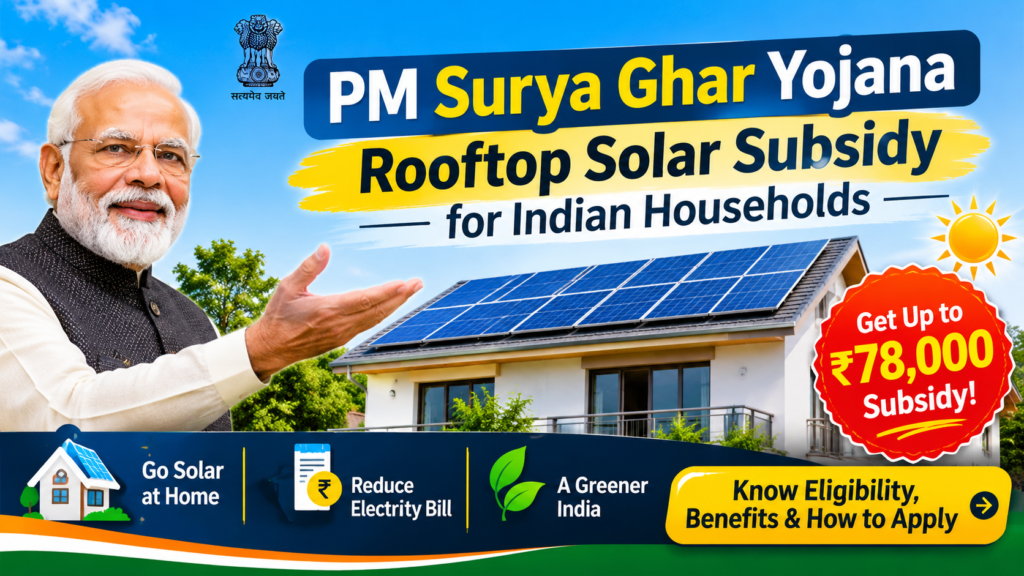
PM Surya Ghar Yojana is a Government of India initiative that encourages households to install rooftop solar panels and reduce their electricity expenses. Through the PM Surya Ghar: Muft Bijli Yojana, eligible residential consumers can receive financial assistance for installing rooftop solar systems.
With rising electricity costs and growing interest in renewable energy, this scheme offers Indian households an opportunity to generate their own electricity while contributing to a cleaner environment.
In this guide, you will learn about the PM Surya Ghar Yojana 2026, including its subsidy amount, eligibility requirements, benefits, required documents and online application process.
What Is PM Surya Ghar Yojana?
The PM Surya Ghar Yojana, officially known as PM Surya Ghar: Muft Bijli Yojana, is a central government scheme launched in February 2024.
The scheme aims to support rooftop solar installations in one crore residential households across India. It is implemented by the Ministry of New and Renewable Energy (MNRE).
The programme provides Central Financial Assistance (CFA) to eligible households that install qualifying rooftop solar systems through the official scheme process.
The main objectives include:
- Making rooftop solar more affordable for Indian households.
- Reducing monthly electricity expenses.
- Encouraging the use of renewable energy.
- Reducing dependence on conventional electricity sources.
- Supporting India’s clean-energy transition.
According to the government’s announcement, the scheme has a total financial outlay of ₹75,021 crore.
For official scheme information, visit the Prime Minister’s Office announcement.
PM Surya Ghar Yojana 2026: Latest Subsidy Details
One of the biggest advantages of the PM Surya Ghar Yojana is the financial assistance available for eligible residential rooftop solar installations.
For general states and Union Territories, the standard central subsidy structure is:
| Solar System Capacity | Government Subsidy |
|---|---|
| 1 kW | ₹30,000 |
| 2 kW | ₹60,000 |
| 3 kW or above | Up to ₹78,000 |
The subsidy is calculated according to eligible installed capacity and applicable scheme guidelines. For systems larger than 3 kW, the central residential subsidy remains capped at ₹78,000 in general states.
Important: Special-category states and Union Territories may have different subsidy rates. Applicants should check the current official portal for the applicable amount.
The subsidy is not an unconditional cash payment for purchasing any solar panel. The installation must meet the scheme requirements, including the applicable vendor, inspection, metering and verification procedures.
Who Is Eligible for PM Surya Ghar Yojana?
Before applying for the PM Surya Ghar Yojana, households should check whether they meet the eligibility conditions.
Generally, applicants must:
- Be Indian citizens.
- Have a valid residential electricity connection from the local DISCOM.
- Have suitable rooftop space or an eligible installation structure.
- Install the system according to the scheme’s technical requirements.
- Select a registered vendor through the official scheme process.
- Meet the applicable subsidy conditions.
Applicants who have already received government assistance for the same solar installation may not qualify for another subsidy.
Commercial and industrial electricity connections are not covered by the residential household subsidy component.
Eligibility and approval can depend on the electricity connection, installation structure and current scheme guidelines.
Documents Required for PM Surya Ghar Yojana
Keep the necessary information and documents ready before beginning your online application.
Commonly required details include:
- Electricity consumer account number or equivalent DISCOM identification.
- Registered mobile number.
- Applicant’s personal details.
- Bank account details for subsidy transfer.
- Required bank proof, such as a cancelled cheque or passbook details, as requested by the portal.
- Installation details and photographs when required during the process.
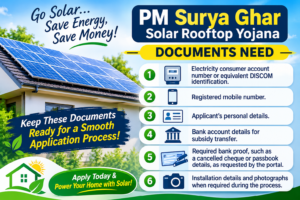
The official portal will guide applicants through the documents required at each stage.
How to Apply for PM Surya Ghar Yojana Online
Eligible households can apply through the official National Portal.
Follow these steps:
Step 1: Visit the Official PM Surya Ghar Yojana Portal
Open the official website:
Choose the consumer registration option to begin.
Step 2: Register Your Electricity Connection
Select your state and electricity distribution company (DISCOM). Enter the required consumer account details and mobile number.
Complete the registration process using the instructions provided on the portal.
Step 3: Submit Your Rooftop Solar Application
Log in to your registered account and submit the rooftop solar application.
Provide the requested details about your electricity connection and proposed solar installation.
Step 4: Complete the Applicable DISCOM Process
Follow the portal instructions for technical feasibility or other applicable approval requirements.
Do not purchase or install a system before checking the current application requirements.
Step 5: Select a Registered Solar Vendor
Choose an eligible vendor listed on the National Portal.
Discuss the proposed system capacity, equipment specifications, installation costs, warranty and maintenance arrangements before finalising the work.
Step 6: Install the Rooftop Solar System
The selected vendor will install the solar system according to the approved requirements.
Ensure that the installation follows the scheme’s technical and equipment standards.
Step 7: Complete Metering and Inspection
After installation, submit the required system details and documents through the portal.
Complete the applicable DISCOM inspection, commissioning and net-metering process.
Step 8: Submit Bank Details and Claim the Subsidy
Provide the required bank information and complete the subsidy claim process.
After successful verification and approval, the eligible subsidy is transferred to the beneficiary’s bank account through the prescribed process.
Tip: Keep your application ID, installation records and payment documents safe so you can track your application and resolve any issues.
Benefits of PM Surya Ghar Yojana for Indian Households
The PM Surya Ghar Yojana offers several potential benefits to residential electricity consumers.
1. Reduced Electricity Bills
Rooftop solar panels generate electricity from sunlight. Households can use the electricity they generate and reduce the amount of power they need to purchase from the grid.
Actual savings depend on system capacity, sunlight, household consumption, tariffs and applicable net-metering rules.
2. Government Subsidy Support
The central subsidy reduces the initial cost of an eligible rooftop solar installation, making solar energy more accessible to households.
3. Long-Term Energy Savings
A properly installed and maintained solar system can generate electricity over many years. This can help households manage their electricity expenses over the system’s useful life.
4. Greater Energy Independence
Generating electricity at home can reduce dependence on conventional grid electricity during suitable daylight conditions.
5. Environmental Benefits
Solar power is a renewable energy source. Using rooftop solar can help reduce dependence on electricity generated from fossil fuels and support lower operational carbon emissions.
How PM Surya Ghar Yojana Supports Environmental Sustainability
The PM Surya Ghar Yojana is not only about reducing electricity bills. It also supports India’s wider renewable-energy and environmental sustainability goals.
Traditional electricity generation can involve fossil fuels such as coal and natural gas. Rooftop solar allows households to generate electricity using sunlight, reducing their reliance on conventional grid power.
Wider adoption of residential solar can contribute to:
- Lower dependence on fossil-fuel-based electricity.
- Reduced operational greenhouse-gas emissions.
- Greater awareness of clean energy.
- Increased adoption of renewable-energy technologies.
- More sustainable household energy consumption.
Environmental progress also depends on responsible manufacturing, installation, maintenance and recycling of solar equipment.
You can explore more about climate-related initiatives in our article on Clean Development Mechanism and environmental developments in 2026.
You can also discover practical ways to make everyday choices more sustainable through our guide to eco-conscious gift ideas for every occasion.
PM Surya Ghar Yojana in West Bengal
Households in West Bengal can explore the PM Surya Ghar Yojana through the National Portal.
Applicants should identify their electricity distribution company, such as WBSEDCL or CESC, according to their connection.
Before installing rooftop solar panels, check:
- Whether your electricity connection is eligible.
- Whether your rooftop is suitable for installation.
- Which registered vendors serve your area.
- What metering and inspection requirements apply.
- Which subsidy amount is applicable to your location.
Do not assume that every household will receive the same savings or subsidy. The final benefit depends on the applicable scheme rules and the approved installation.
Things to Check Before Installing Rooftop Solar Panels
Although the PM Surya Ghar Yojana provides financial support, households should carefully evaluate their installation before proceeding.
Consider these points:
- Roof condition: Make sure the roof can safely support the solar panels and mounting structure.
- Sunlight availability: Check whether nearby buildings, trees or other obstacles create significant shading.
- System capacity: Choose a suitable capacity based on household electricity consumption.
- Vendor registration: Select a vendor listed on the official portal.
- Equipment quality: Check the specifications, warranty and applicable scheme requirements.
- Installation cost: Ask for a clear written quotation covering equipment, installation and other charges.
- Maintenance: Understand cleaning, servicing and warranty arrangements.
A careful assessment can help avoid unnecessary expenses and installation problems.
The Future of Rooftop Solar Energy in India
India is steadily expanding its renewable-energy capacity, and residential rooftop solar is an important part of this transition.
Government initiatives such as the PM Surya Ghar Yojana encourage households to participate in clean-energy adoption rather than depending entirely on conventional electricity sources.
As solar technology develops and awareness increases, rooftop solar may become an increasingly practical option for residential buildings.
However, long-term success will also depend on reliable installation services, suitable financing, effective maintenance, grid infrastructure and responsible disposal of solar equipment.
Sustainability is connected to many everyday choices. You can read more about environmental volunteering and travel that makes a difference and explore how sustainable fashion in India is changing consumer habits.
Frequently Asked Questions About PM Surya Ghar Yojana
1. What is PM Surya Ghar Yojana?
PM Surya Ghar Yojana is a central government scheme that provides financial assistance to eligible residential households for installing rooftop solar systems.
2. How much subsidy is available under PM Surya Ghar Yojana?
In general states and Union Territories, the central subsidy is ₹30,000 for 1 kW, ₹60,000 for 2 kW and up to ₹78,000 for 3 kW or higher-capacity systems, subject to scheme conditions.
3. Who can apply for PM Surya Ghar Yojana?
Eligible Indian residential electricity consumers with a valid grid-connected electricity connection can apply, subject to the scheme’s requirements.
4. How can I apply for PM Surya Ghar Yojana online?
Visit the official National Portal at https://pmsuryaghar.gov.in/, register your electricity connection, submit the application and follow the approval and installation process.
5. Is PM Surya Ghar Yojana available in West Bengal?
Eligible residential consumers in West Bengal can apply through the National Portal, subject to the applicable DISCOM and scheme requirements.
6. Is the subsidy transferred directly to the bank account?
Eligible subsidy is transferred through the prescribed process after the installation, required documentation and verification have been completed successfully.
7. Can tenants apply for PM Surya Ghar Yojana?
Applicants need the necessary rights and permissions for the rooftop installation and an eligible electricity connection. Tenants should obtain the property owner’s permission and check the portal’s requirements before applying.
8. Does the scheme guarantee 300 units of free electricity every month?
No. The scheme’s objective refers to providing households with the potential to receive up to 300 units of free electricity per month through rooftop solar. Actual generation, consumption and electricity bills depend on the installed system and applicable electricity rules.
9. Can commercial buildings receive the residential subsidy?
The central financial assistance component discussed in this article is intended for eligible residential consumers. Commercial and industrial connections are not covered under this residential subsidy component.
10. Where can I check my PM Surya Ghar Yojana application status?
Applicants can log in to the official National Portal and use their registered account and application details to track the status.
Final Thoughts
The PM Surya Ghar Yojana provides an opportunity for eligible Indian households to adopt rooftop solar energy with government financial assistance.
By reducing the initial installation cost and encouraging renewable-energy use, the scheme can help households manage electricity expenses while supporting India’s clean-energy transition.
Before applying, check your eligibility, compare registered vendors, understand the installation requirements and follow the official application process.
For the latest guidelines, subsidy details and application updates, always refer to the official PM Surya Ghar Yojana portal.
This article is for general information. Scheme conditions, subsidy rates and application procedures may change. Verify the latest requirements through official government sources before applying.